GPS Tracking - Number Locator
- 4.1
- Rating
- 100.00K
- Installs
- Free
- Price

 Analysis by App-foxy
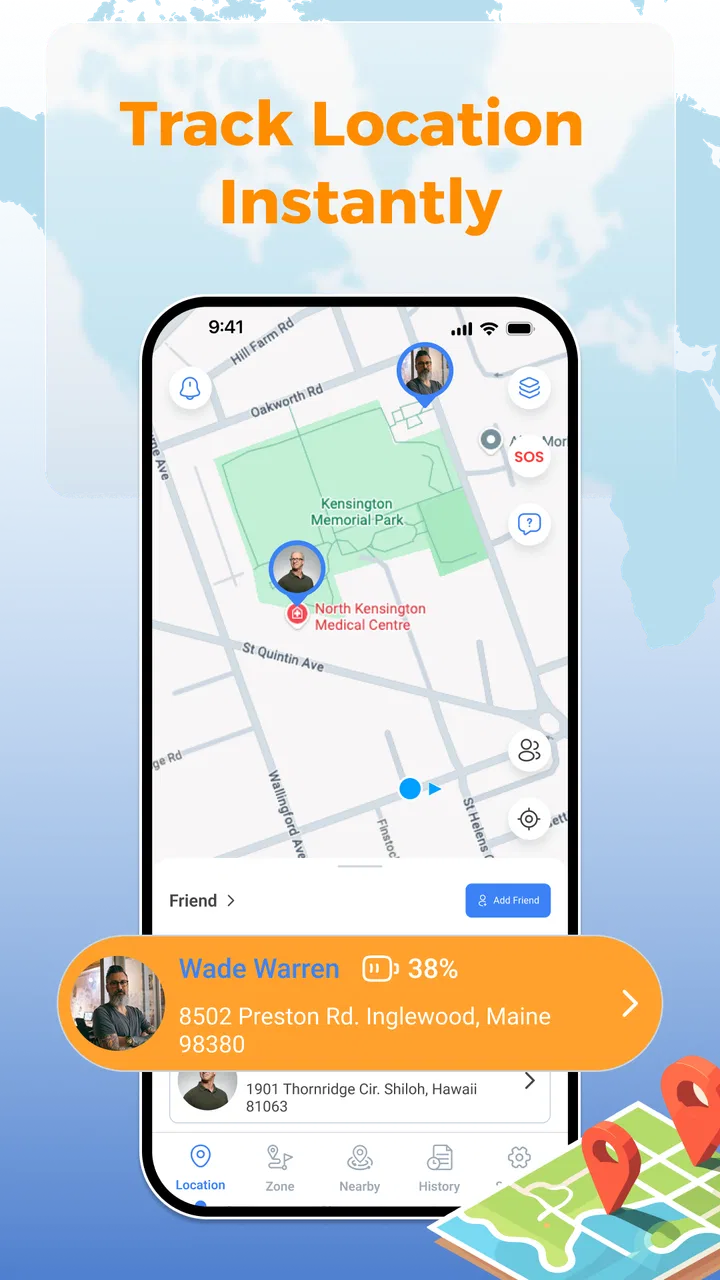
I tried GPS Tracking - Number Locator as the kind of utility you open with one practical question: “Where is the person I need to check on?” Its purpose sits between a simple map tool and a family-safety service, using GPS tracking and number-based location ideas to make real-time location easier to follow. My first impression was that it is more focused than a general navigation app, but that focus also means its value depends heavily on whether the people around you are willing to use it consistently.
This is a free Android app in the Maps & Navigation category, developed by サウズヒロ. It is intended for Everyone, and the current release is version 1.0.2. The app has reached over one hundred thousand installs and holds a 4.1 average from around two hundred ratings, which suggests that it has found a useful audience while still leaving room for mixed experiences. It was released on April 1, 2026, and works on Android 9 or later.
From a useful first week to a realistic long-term test
I’d use this section to judge whether the app still earns a place after the first few days, when checking a moving marker feels less novel. A useful long-term test is to compare the household’s actual routine before and after adopting it: fewer unnecessary check-ins is a gain, but repeated refreshing or tension about sharing is a sign to rethink the arrangement.
You May Also Like

 Blood Strike: 2.5 Anniversary
Blood Strike’s Loadouts Turn Every Drop Into a Tactical Gamble
A close look at Blood Strike’s custom loadouts: how fast access to signature weapons reshapes its battle royale rhythm, rewards preparation, and narrows the gap between fights.

 Pandora - Music & Podcasts
Pandora’s Music Is Easy to Start, but Harder to Recover
Pandora’s strength is its low-effort path from a seed to a station. Its weak spot is how much confidence it asks you to place in connection, setup, and quiet recovery.

 8 Ball Pool
 Is Built on Rivalries, Rematches, and Routine
A close look at the rivalries, rematches, shared routines, and unanswered safety questions that turn a quick pool match into a persistent mobile community.

 Samsung Music
’s Quiet Strength Is Playing What You Already Own
Its reach comes less from spectacle than from dependable access to a personal library. That simplicity is both the app’s strongest retention engine and its ceiling.

 AccuWeather: Weather Radar
AccuWeather Review: A Quick, Clear Forecast for Everyday Decisions
For everyday plans, the best forecast is the one you can understand quickly. AccuWeather makes rain timing, radar, and local conditions easy to act on, with a few trade-offs.

 Hill Climb Racing
Why Hill Climb Racing Still Turns Crashes Into One More Run
A tiny car, a bumpy hill and one more upgrade: Hill Climb Racing keeps resurfacing because its simple chaos makes every near-miss feel personal.
More From Our News Desk



Why the first week feels promising
The appeal is easy to understand during the first few days. A location-focused app can remove the need to exchange repeated messages such as “Have you arrived?” or “Are you still on the way?” For a family member commuting alone, a child travelling between familiar places, or someone coordinating a meeting point, a live position can be more useful than a vague text update.
I also like the idea of keeping location checking separate from a full navigation application. Google Maps and similar tools are excellent when I need directions, traffic information, or a route. They are not always the most natural place to manage a simple “let me see where this person is” routine. This app is aimed at that narrower moment, which makes it easier to understand when the need is specifically about tracking rather than travelling.
The number-locator angle may initially make the app feel more convenient than a traditional map-sharing workflow. Instead of building a complicated process around routes, destinations, and navigation settings, the concept points toward identifying a person through a phone number and viewing a location. That is a useful starting point for families who do not want to learn a large, feature-heavy platform.
Still, I would not treat a phone number as a magic key that removes every practical step. Location tools work best when the people involved understand what is being shared and how the app is meant to be used. A good first-week setup is to agree on a specific purpose: checking a journey home, coordinating a pickup, or keeping an eye on a family member during a normal routine. That is much more manageable than asking everyone to leave location tracking running without a clear reason.
A realistic everyday scenario
Imagine a parent waiting for a teenager who normally comes home after an activity. Rather than sending several messages, the parent can use the location workflow to see whether the journey is progressing. If the person is delayed, the map may provide useful context before anyone starts worrying. The benefit is not that the app replaces communication; it is that it can reduce unnecessary interruptions when a quick glance answers the immediate question.
Another practical situation is meeting someone at a busy public place. A shared position can be more helpful than trying to describe which entrance, corner, or nearby shop each person can see. In that case, the app earns its place by shortening coordination, not by offering a sophisticated travel plan.
There is also a less obvious use: creating a simple household routine around arrival checks. For example, family members might agree that location is checked only during a particular commute and that a message is still sent when plans change. This combination is safer and less tiring than expecting the map to explain every delay. The app can show where someone is, but it cannot reliably explain why they stopped, changed direction, or lost signal.
What changes after the novelty fades
The first week is when location tracking feels most impressive because every movement is new. After that, the real question becomes whether the app solves a recurring problem often enough to justify keeping it installed. In my view, its lasting value is strongest for households with a repeated coordination need. If the same people regularly travel alone, meet at changing locations, or need occasional reassurance, a focused tracker can become part of a useful routine.
For occasional use, the benefit is less certain. If I only need to find someone once every few months, a normal map-sharing option may be simpler because it is already familiar to many people. The extra value here comes from turning location checking into a dedicated habit, not from opening it once and expecting a dramatic improvement over every alternative.
This is also where the difference between tracking and navigation matters. A navigation app helps me decide how to get somewhere. GPS Tracking - Number Locator is more relevant after another person is already moving and I want situational awareness. Choosing the wrong type of tool can create frustration: someone looking for turn-by-turn directions may find a tracker too limited, while someone trying to monitor a journey may find a full navigation app unnecessarily busy.
I would judge the app month by month using a simple test: does it prevent repeated check-in messages, make pickups easier, or provide reassurance during a predictable journey? If the answer is yes, it has recurring value. If I still depend on another messaging app to arrange every detail and only open this one out of curiosity, the novelty has probably already passed.
The maintenance hidden inside location sharing
Location tracking is never completely passive from a user’s point of view. Even when the app is straightforward, the people using it need to remember the agreed routine, keep the right account or number associated with the right person, and understand what a displayed position actually means. That human maintenance is more important than the map itself.
I recommend setting expectations before relying on the app. Decide who is being tracked, when checking is appropriate, and what to do if the position looks old or unexpected. A tracker should not become a reason to repeatedly question someone’s movements. Clear boundaries make the tool feel supportive rather than intrusive, especially when used between adults or with older children.
Another useful habit is to treat the displayed location as an aid, not proof of perfect precision. GPS readings can vary because of buildings, weak reception, movement, or delays between updates. If a person appears to be in the wrong place, I would first contact them rather than drawing a conclusion from the screen. This is one of the most important practical lessons with any real-time location product, and it prevents a small technical irregularity from becoming a larger personal argument.
Maintenance also means reviewing whether the arrangement still makes sense. A family may need tracking during a new commute but not after schedules change. A friend may share a location for a single meeting and then stop. Keeping the app useful requires removing old expectations instead of allowing temporary sharing to become a permanent background habit.
Where fatigue begins
The biggest source of fatigue is not necessarily opening the app; it is the attention that location sharing can create. If people feel watched throughout the day, they may stop cooperating or begin ignoring the system. A tool intended for safety can lose its value when it becomes associated with constant checking.
Notification and battery concerns can also influence long-term willingness, even when the basic idea is helpful. I would avoid using continuous tracking for every minor movement and reserve it for defined situations. That approach reduces the feeling that the app is always active in the background and makes each check more meaningful.
There is a second kind of fatigue: false confidence. Seeing a moving marker can make a user believe they have complete awareness, but a map cannot tell me whether someone is safe, whether they need help, or whether their plans have changed. It is especially important not to use location alone as a substitute for a call in an urgent situation.
The phone-number concept may also create confusion if users expect it to identify anyone automatically. In a responsible setup, the person being located should understand the arrangement and participate in it. If someone is uncomfortable sharing their position, this is not the right tool for forcing an answer. A family may be better served by an agreed check-in message, while a group of friends may prefer temporary sharing through a service they already use.
How it compares with familiar alternatives
Compared with a general navigation app, this product has a clearer tracking identity. A navigation service is usually better for route planning, directions, traffic, and exploring places. This app makes more sense when the central question is the location of a person rather than the route to a destination.
Compared with ordinary messaging, the advantage is visual context. A message says what someone reports; a map can show where the person appears to be. The trade-off is that messaging is often more flexible for explanations, changes, and reassurance. In practice, I would use the tracker for location and messaging for meaning. Neither one fully replaces the other.
Compared with a dedicated family-safety platform, the likely attraction here is a narrower, less intimidating purpose. A large safety suite may be a better choice for households wanting a broad collection of controls and monitoring tools. On the other hand, people who only want a focused way to check a location may prefer not to manage a larger system. The right choice depends on whether simplicity or a wider safety toolkit matters more.
There is also a privacy trade-off. A dedicated tracker can make location checking feel routine, but that convenience should not lead to automatic sharing with everyone. I would choose this app for a small, trusted circle and a clearly defined need. I would skip it if the goal is public location broadcasting, detailed travel planning, or surveillance without consent.
Practical ways to make the app less tiring
My first tip is to start with one recurring journey rather than tracking every activity. A regular commute gives the app a clear job and makes it easier to judge whether it is genuinely useful. If it reduces messages or makes a pickup smoother, expand the routine carefully. If it adds more checking than it removes, stop there.
My second tip is to pair a map check with a simple rule. For example, a position can tell me whether someone is still travelling, while a message is required if plans change. This prevents the app from carrying responsibilities it was never designed to handle.
My third tip is to agree on what counts as an emergency before an emergency happens. If a marker remains in one place longer than expected, the next step should be a call or another trusted contact method, not repeated refreshing. That small decision makes the technology more useful because it connects the map to a human response.
Finally, I would periodically ask whether every person still wants to participate. Long-term value depends on cooperation. If one member stops using the app, the household should adjust the routine rather than pretending the tracking system is still complete.
Who should use it, and who should look elsewhere
I can recommend GPS Tracking - Number Locator to Android users who want a focused location tool for a trusted family or small group. It is particularly suitable when the same journeys happen repeatedly and the main benefit is reducing uncertainty between departure and arrival. The free price also makes it easy to try without turning the first experiment into a financial commitment.
I would be more cautious about recommending it to someone who expects perfect precision, instant explanations, or a complete emergency-response system. It is also not my first choice for someone primarily seeking turn-by-turn navigation, route discovery, or a broad suite of parental controls. In those cases, a familiar navigation app, messaging service, or more comprehensive family platform may fit better.
The age rating of Everyone makes the app broadly approachable, but that should not be confused with a universal recommendation for unsupervised location sharing. Families still need their own rules about consent, privacy, and communication. The app can support a safety routine; it cannot create trust by itself.
My long-term verdict
After the initial curiosity wears off, this app earns lasting space only when it is attached to a real, repeated need. Its strongest quality is focus: it is built around checking location rather than asking users to navigate a large collection of unrelated tools. That makes it easy to understand in the right household and potentially valuable during regular commutes, pickups, and meetups.
Its weakness is equally clear. Location tracking can become repetitive, socially uncomfortable, or misleading when users expect the map to provide complete certainty. The app needs a light maintenance routine, sensible boundaries, and a backup communication method. Without those, the first-week appeal can turn into background clutter.
My final view is positive but selective. I would keep GPS Tracking - Number Locator installed for a trusted group if it consistently saves messages and makes a specific journey easier to manage. I would remove it if nobody checks it regularly or if it encourages more worry than reassurance. The lasting value comes from a small, respectful habit, not from watching a map all day. That is the standard I would use before giving it a permanent place on my phone.
FAQs for GPS Tracking - Number Locator
01What is GPS Tracking - Number Locator, and what does it do?
GPS Tracking - Number Locator is designed to help users identify a phone number’s general location and access location-related tools from a mobile device. During testing, it is important to understand that a number locator usually provides approximate information based on country, region, carrier, or publicly available data. It is not the same as real-time GPS tracking, and results may vary depending on the number, network, permissions, and available databases.
02Can GPS Tracking - Number Locator track someone in real time without their permission?
No. A legitimate app cannot secretly provide another person’s precise, live GPS location simply from their phone number. Real-time location sharing normally requires the other person to install or use a compatible service, enable location services, and grant explicit permission. Users should be cautious of any claim promising invisible tracking, since such features may be misleading, violate privacy laws, or expose personal information to security risks.
03Does the app show an exact address or only an approximate location?
Users should generally expect approximate results rather than an exact street address. Phone-number lookup systems may identify a country, area, carrier, or broad regional information, but mobile numbers can be transferred between carriers and people may use them while traveling. GPS accuracy also depends on signal quality, device settings, and permission access. The app should therefore be treated as an informational tool, not a substitute for emergency location services.
04What permissions and personal information does the app require?
Before using GPS Tracking - Number Locator, review the permission requests and the developer’s privacy policy carefully. Depending on the available features, the app may request access to location, contacts, phone-related information, notifications, or network data. Only grant permissions that are necessary for the feature you want to use. If a request seems unrelated, deny it and check how collected data is stored, shared, and deleted.
05Is GPS Tracking - Number Locator free to use, and are there subscriptions or extra charges?
The app may offer basic tools at no cost while placing advanced searches, unlimited lookups, or additional location features behind in-app purchases or a subscription. Pricing, trial periods, and renewal terms can change, so check the current Google Play or App Store listing before downloading. If a free trial is offered, read the cancellation instructions carefully and cancel through your platform’s subscription settings before renewal if you do not want to continue.
Pros
- Simple interface makes location tools easy to find and use.
- May help identify a phone’s approximate area in emergencies.
- Useful for checking basic location information while traveling.
- Lightweight design should work smoothly on many Android devices.
- Can provide reassurance when trying to locate a misplaced device.
Cons
- Location results may be inaccurate in buildings or weak-signal areas.
- Some features may require payment or a recurring subscription.
- Number lookup cannot reliably reveal a person’s live location.
- The app may request sensitive location and phone-related permissions.
- Background tracking can increase battery consumption and privacy concerns.

GPS Tracking - Number Locator
Gallery